For chemistry students · 4 minute read
Why does sodium carbonate fizz with hydrochloric acid?
Sodium carbonate reacts with hydrochloric acid to form sodium chloride, water, and carbon dioxide gas. The escaping carbon dioxide is what makes the mixture fizz.
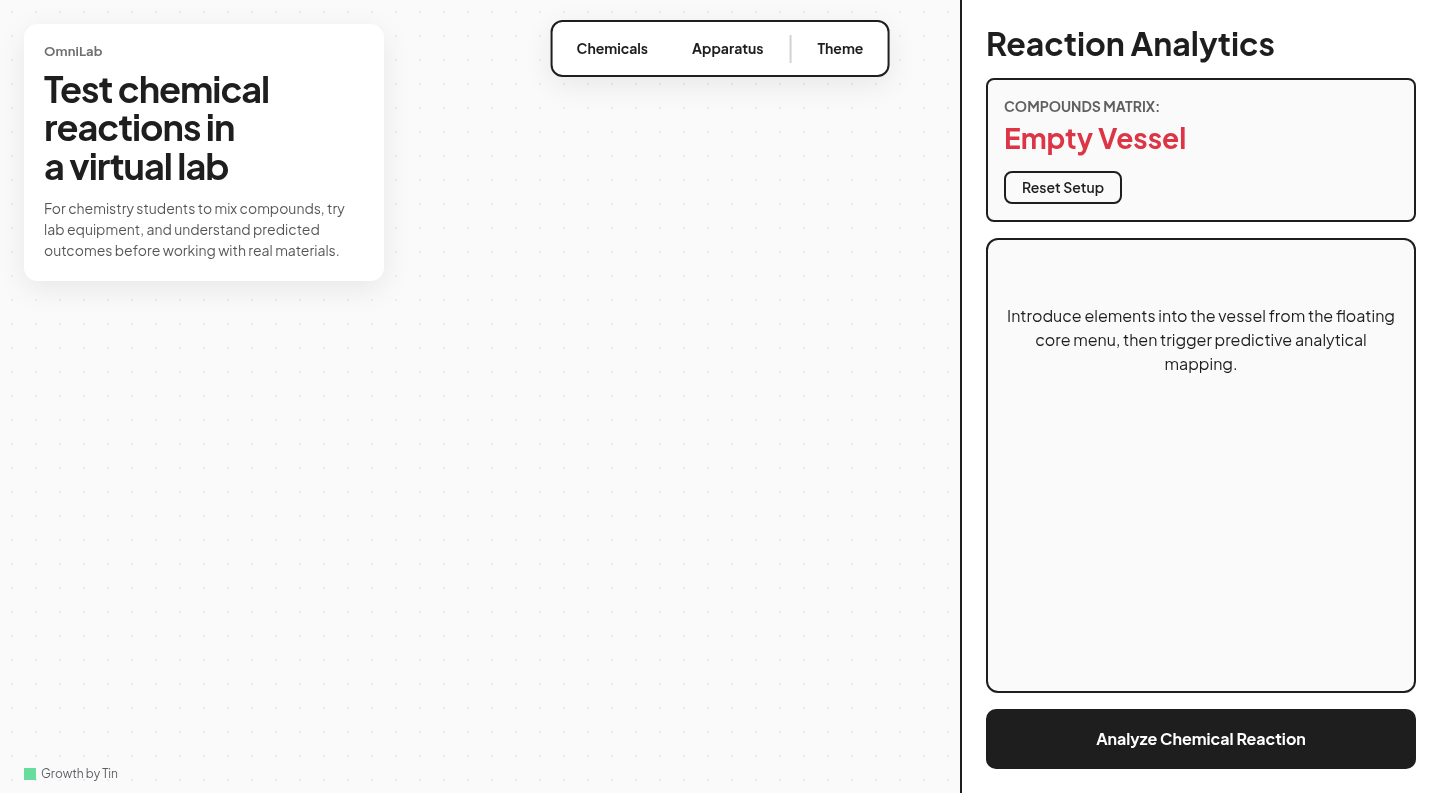
Try the fizzing setupThe exact supported pair opens in a beaker. Nothing runs until you select Analyze.
Supported prediction
Na2CO3(aq) + 2HCl(aq) -> 2NaCl(aq) + CO2(g) + H2O(l)
What the equation means
Sodium carbonate reacts with hydrochloric acid to form sodium chloride, carbon dioxide, and water. Carbon dioxide escaping from the solution causes bubbling. Two hydrogen ions are needed for each carbonate ion in the balanced equation.
Expected observation
Carbon dioxide bubbles
OmniLab shows a bounded bubble cue inside the beaker to represent the expected gas evolution.
Three safety notes
Read these before any physical experiment
- 01
Wear splash goggles and acid-resistant gloves.
- 02
Add hydrochloric acid slowly to control foaming and heat.
- 03
Keep the vessel open and work in a ventilated area.
Keep exploring
Connect this observation to another reaction
These guides use the same pattern: predict the equation, identify the visible cue, then check what the virtual model leaves out.
See how the full virtual lab works