For chemistry students · 4 minute read
Why do sodium and chlorine form an ionic bond?
Sodium transfers an electron to chlorine, creating Na⁺ and Cl⁻. Their opposite charges attract, forming an ionic lattice.
Try Sodium + ChlorineNo account or payment required in the current public release.
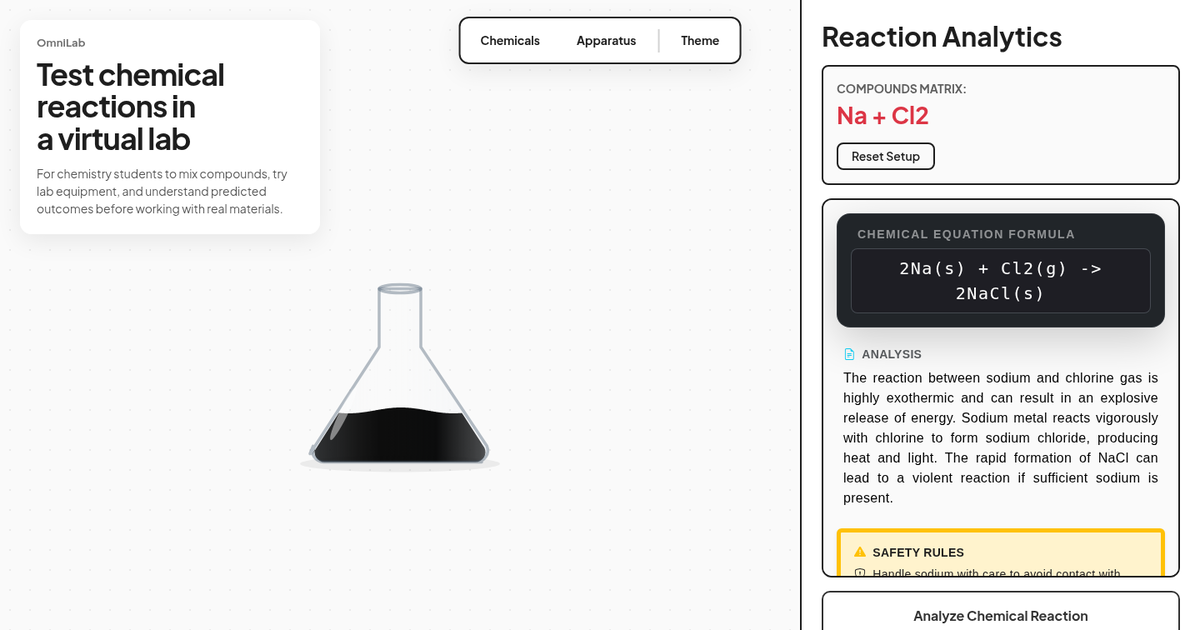 Real OmniLab workspace
Electron transfer model
Na → Na⁺ + e⁻ | Cl + e⁻ → Cl⁻
In the full elemental reaction, one Cl₂ molecule accepts two electrons from two sodium atoms.
Worked explanation
From neutral atoms to an ionic lattice
Use this as a study aid, then compare it with your course materials.
-
01
Sodium loses one electron
A neutral sodium atom becomes Na⁺ when it gives up its outer electron.
-
02
Chlorine gains that electron
A chlorine atom becomes Cl⁻ after accepting one electron, giving the two ions opposite charges.
-
03
Attraction builds the solid
Electrostatic attraction holds many Na⁺ and Cl⁻ ions in a repeating three-dimensional sodium chloride lattice.
In the virtual lab
What the virtual prediction can show
- The lab can return an equation and short explanation.
- Its result is generated and may be incomplete or wrong.
- Use a textbook or instructor to verify the bonding model.